Reinforcing Soil Stability in Modern Highway Development: road construction geogrid
Release time:2026-03-05 Click:13
As traffic volumes and vehicle weights increase, so do demands on pavement foundations. Road construction geogrid has become indispensable in stabilizing subgrades, distributing loads, and extending the life of asphalt and concrete surfaces—especially over weak soils or expansive clays.
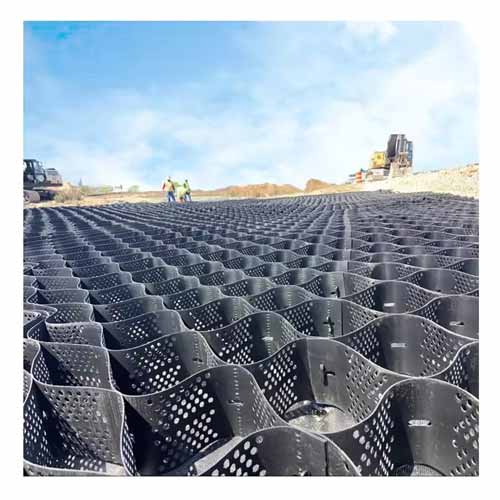
Made from high-tenacity polyester, polypropylene, or fiberglass yarns, road construction geogrid features a rigid, open-aperture matrix that interlocks with aggregate particles. When placed between subgrade and base course, it creates a mechanically stabilized layer that reduces rutting, minimizes differential settlement, and cuts required base thickness by up to 30%.
The mechanism is twofold: confinement and tensioned membrane effect. Aggregate locked within apertures resists lateral movement, while the geogrid itself carries tensile stresses that would otherwise deform soft soil. Biaxial grids (equal strength in both directions) suit general road bases; uniaxial versions anchor retaining walls or steep slopes.
Installation is straightforward—rolls are laid perpendicular to traffic direction, overlapped per spec, and covered immediately to prevent UV degradation. Quality control includes tensile strength tests (ASTM D6637) and junction efficiency checks. Innovations like geogrid-geotextile composites now offer combined filtration and reinforcement in one layer.
In conclusion, road construction geogrid transforms marginal ground into reliable infrastructure. By harnessing geosynthetic engineering, it delivers smoother rides, lower emissions from reduced material haul, and roads that last decades longer—proving that sometimes, the strongest foundation is woven, not poured.
Previous article:Reliable Geogrid for Embankment & Slope Reinforcement
Next article:Understanding Geomembrane Technology in Modern Engineering
Hot products
Mobile: +86 15097722953
Email:metalproducts2021@163.com
Email:1755383270@qq.com