Warp-Knitted Polyester Geogrid: Reinforcing Infrastructure for the Future
Release time:2026-02-19 Click:19
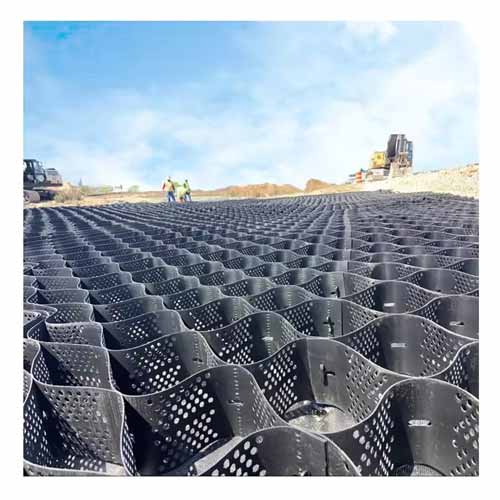
Warp-knitted polyester geogrid is a high-performance geosynthetic material that is revolutionizing civil engineering by providing superior tensile reinforcement for soil structures. Manufactured from high-tenacity polyester yarns coated with a protective polymer, these geogrids feature a stable, open grid structure created by a precise warp-knitting process followed by a coating and stretching (pre-tensioning) stage. Their primary function is to be embedded within soil or aggregate layers to distribute loads, reduce rutting, improve stability, and allow for the construction of steepened slopes and reinforced walls, thereby enabling more resilient, cost-effective, and sustainable infrastructure.
The manufacturing technique is key to its performance. High-modulus polyester yarns are knitted on large machines in a warp-knit pattern, creating dimensionally stable apertures. This knitted fabric is then coated with a polymeric material (like PVC or latex) to protect the fibers from installation damage and long-term environmental degradation, including ultraviolet radiation and chemical/biological attack. A critical final step is the pre-tensioning of the grid, which aligns the molecular structure of the polyester yarns, significantly enhancing their tensile modulus (stiffness) and creep resistance—the ability to maintain strength under long-term constant load.
When incorporated into soil, the geogrid interacts mechanically through interlock with the surrounding particles. The open apertures allow soil to penetrate through and around the grid, creating a strong composite material. This interaction confines the soil, increasing its shear strength and allowing it to withstand greater tensile forces than unreinforced soil. This mechanism is utilized to build reinforced soil walls (MSE walls), stabilize steep slopes, reinforce soft subgrades beneath roads and railways, and provide base reinforcement for parking lots and working platforms on weak soils.
The advantages over traditional materials like metal grids or random-fiber geotextiles are profound. Polyester geogrids are lightweight, easy to handle and install, and highly resistant to corrosion and chemical attack, ensuring a design life exceeding 120 years in many applications. Their high tensile strength at low strain makes them exceptionally effective at limiting deformation. The flexibility of the material allows it to conform to uneven subgrades and accommodate some differential settlement without failure. This leads to reduced construction costs, less use of virgin aggregate, and the ability to build on sites previously considered unsuitable.
Adopting warp-knitted polyester geogrid technology is a forward-looking strategy for building the durable infrastructure of the future. It enables engineers to design stronger, taller, and more stable earth structures with greater confidence. By improving the performance and longevity of roads, railways, retaining walls, and embankments, it reduces lifecycle maintenance costs and minimizes environmental impact. As demands on global infrastructure grow, this advanced reinforcing solution plays a pivotal role in creating a built environment that is safer, more economical, and sustainable for generations to come.
Previous article:Ground Stabilization: Geogrid Soil Reinforcement
Next article:Corrosion Resistant Stretched Geogrid Ensures Longevity Outdoors
Hot products
Mobile: +86 15097722953
Email:metalproducts2021@163.com
Email:1755383270@qq.com