Ground Stabilization: Geogrid Soil Reinforcement
Release time:2026-02-18 Click:19
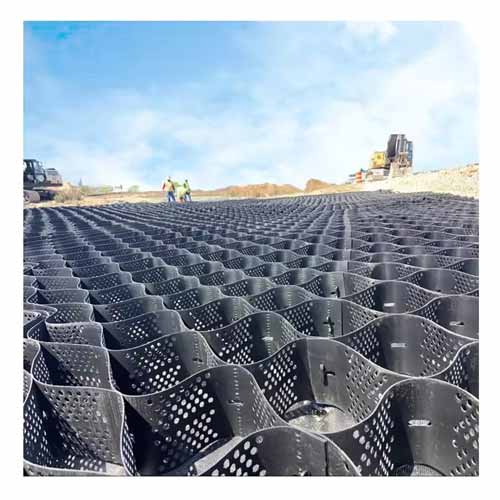
Geogrid soil reinforcement is a geosynthetic material used to improve the mechanical properties of soil, primarily for road construction, retaining walls, and slope stabilization. Made from high-density polyethylene (HDPE) or polyester, geogrids consist of a grid-like structure with apertures (openings) that allow soil particles to interlock with the ribs, creating a composite material with higher tensile strength and stiffness than the soil alone.1. This interlocking mechanism is the key to its function; it restricts the lateral movement of soil, reducing settlement and increasing bearing capacity. In road construction, geogrids are placed in the base layer to distribute heavy axle loads over a wider area, preventing rutting and extending the pavement's service life. For steep slopes or embankments, they act as a "tensile element" that holds the soil mass together, preventing landslides and erosion caused by heavy rainfall.
The manufacturing of geogrid soil reinforcement involves extrusion and biaxial or uniaxial stretching processes. Biaxial geogrids (stretched in both machine and transverse directions) offer balanced strength in all directions, making them ideal for base stabilization where loads are multidirectional. Uniaxial geogrids (stretched primarily in one direction) provide extremely high tensile strength in the roll direction, suited for retaining walls where the force is primarily horizontal. The polymer ribs are often coated or wrapped with a bituminous or PVC layer to increase the friction coefficient with the soil and to protect against installation damage (abrasion from rocks). The junction points where the ribs intersect are ultrasonically welded or bonded to ensure they don't separate under load. The aperture size is critical; it must be large enough to allow soil aggregate to pass through and lock in place, but small enough to prevent the grid from sinking into soft subgrades.
Installation of geogrid soil reinforcement requires careful site preparation. The subgrade must be leveled and compacted to provide a stable foundation. The geogrid roll is unrolled smoothly over the prepared surface, ensuring it is under slight tension (but not stretched beyond its elastic limit) to prevent wrinkling or "bunching." Overlaps at the seams (typically 30-60cm) are mandatory to maintain continuity of the reinforcement.1. For steep slopes, the geogrid is anchored into a "key trench" at the top of the slope and wrapped around the face, often combined with shotcrete or vegetation for erosion control. In roadways, a layer of granular fill (sand or gravel) is placed directly over the geogrid before compaction; this fill protects the plastic from UV degradation and distributes the load. Traffic can usually be allowed on the geogrid layer immediately after the fill is placed, as the grid provides immediate stabilization.
Maintenance of geogrid soil reinforcement is passive; once buried, it is protected from environmental degradation. However, its performance relies on proper drainage. If water accumulates behind a retaining wall or within a road base, hydrostatic pressure can reduce the effective stress and compromise the grid's friction with the soil. Therefore, weep holes or drainage layers are essential components of any geogrid system. In slopes, surface erosion must be controlled with vegetation or riprap to prevent the top layers of soil (and the geogrid) from washing away. While HDPE geogrids are resistant to biological degradation and most chemicals found in soil, they can be vulnerable to prolonged UV exposure if left uncovered during construction. In such cases, the grid should be covered with soil or a tarp within 24-48 hours to prevent embrittlement.
Finally, the economic and environmental impact of geogrid soil reinforcement is profound. By reducing the thickness of the aggregate base required for roads (by up to 50%), it lowers the need for quarrying virgin stone, a significant environmental benefit. It also reduces the carbon footprint of construction by minimizing the transport of heavy materials. In weak soil conditions, geogrids allow for the construction of embankments that would otherwise require expensive deep foundations or pile driving. The material's flexibility allows it to conform to uneven ground, making it suitable for soft, compressible soils where rigid structures would fail. As climate change increases the frequency of extreme weather events, the role of geogrids in flood defense and slope stability becomes increasingly critical. They represent a shift from "fighting" the ground to "working with" it, using tensile strength to complement the compressive strength of soil—a fundamental principle of modern geotechnical engineering that saves billions in infrastructure costs annually.
Previous article:Reinforce Slopes Sustainably with Geomat
Next article:Warp-Knitted Polyester Geogrid: Reinforcing Infrastructure for the Future
Hot products
Mobile: +86 15097722953
Email:metalproducts2021@163.com
Email:1755383270@qq.com