Product details description
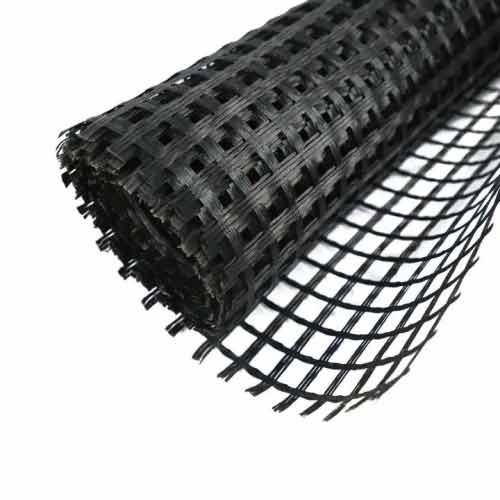
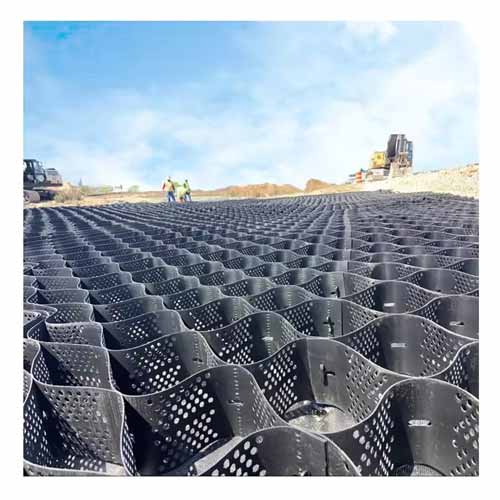
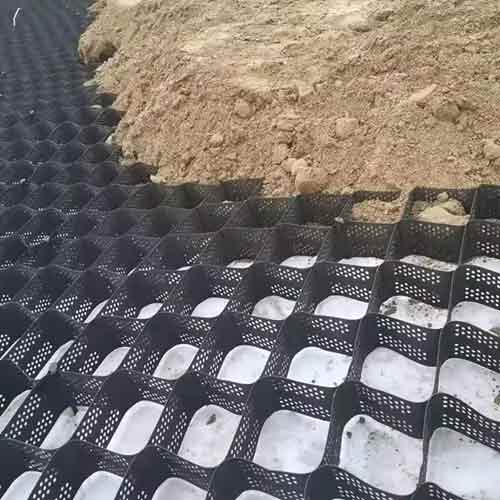
Geogrids, polymeric mesh materials engineered to reinforce soil, have
revolutionized civil engineering by enhancing the stability and load-bearing
capacity of weak or soft soils. Used in road construction, embankments,
retaining walls, and foundation stabilization, they distribute tensile stresses,
reduce settlement, and prevent soil erosion. Their unique structure—comprising
interconnected ribs and apertures—enables them to interlock with soil particles,
creating a composite material stronger than either component alone.
The mechanism of soil reinforcement hinges on geogrid-soil interaction.
When placed within a soil mass, the geogrid’s ribs confine soil particles,
preventing lateral displacement under load. The apertures (typically 10–100 mm)
allow soil to penetrate and interlock, transferring vertical loads horizontally
and reducing differential settlement. This synergy increases the soil’s
effective shear strength and modulus of elasticity, enabling it to support
heavier structures or withstand dynamic forces (e.g., traffic, earthquakes).
High-strength polymers (polyester, polypropylene, or fiberglass) used in
geogrids provide tensile strengths ranging from 20–200 kN/m, tailored to
application needs.
Structural applications are diverse and critical. In road construction,
geogrids are laid at the subgrade-base interface to reinforce soft soils,
reducing rutting and extending pavement life by 2–3 times. For embankments on
weak foundations, they prevent slope failure by distributing the embankment’s
weight and stabilizing the underlying soil. Retaining walls benefit from
geogrids as reinforced earth structures: multiple layers of geogrid are embedded
in compacted backfill, creating a mechanically stabilized earth (MSE) wall that
resists overturning and sliding. In foundation stabilization, geogrids reinforce
loose sands or silts, enabling the construction of buildings or bridges on
previously unsuitable sites.
Benefits extend beyond structural integrity. Geogrids reduce construction
costs by minimizing the need for soil replacement or deep foundations—for
example, a road project on soft clay can save 30–50% in excavation and fill
costs. They accelerate construction timelines by allowing faster compaction of
reinforced soil compared to untreated soil. Environmentally, geogrids reduce
quarrying of natural aggregates and lower carbon emissions from heavy machinery.
Their permeability allows water to drain through, preventing hydrostatic
pressure buildup behind retaining walls and reducing erosion risks.
Design and installation require precision to maximize performance.
Engineers conduct geotechnical investigations to determine soil type, strength,
and settlement potential, then select geogrid type (uniaxial for unidirectional
reinforcement, biaxial for multidirectional) and tensile strength. Installation
involves laying geogrids in layers (spaced 300–500 mm apart) and compacting soil
in 150–200 mm lifts to ensure proper interlocking. Overlap between adjacent
geogrid sheets (≥150 mm) prevents stress concentrations. For MSE walls, geogrids
are anchored to facing elements (concrete panels or modular blocks) to resist
pullout forces.
Innovations in geogrid technology continue to expand possibilities.
Biodegradable geogrids (made from polylactic acid) offer temporary reinforcement
for reclamation projects, decomposing after soil stabilization. High-modulus
geogrids (with fiberglass or carbon fibers) enhance performance in high-load
applications like airport runways. Smart geogrids embedded with sensors monitor
strain and soil pressure in real time, enabling predictive maintenance. By
integrating geogrids into soil reinforcement strategies, engineers build
resilient, cost-effective, and sustainable infrastructure.
geogrid for road geogrid machine geocell slope Composite geogrid
Previous article:
Long-Term Performance of Geogrids in Soil Reinforcement
Next article:
Geogrid Long-term Performance: Durability and Maintenance Requirements