Stabilizing Earthworks Through Geogrid Soil Reinforcement Technology
Release time:2026-02-03 Click:23
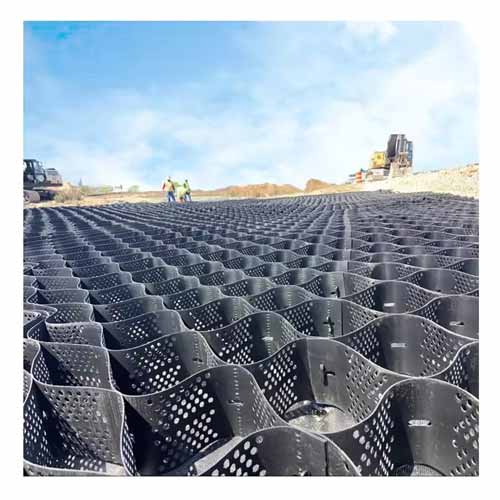
Modern civil engineering increasingly relies on geogrid soil reinforcement to construct stable embankments, retaining walls, and road bases on weak or expansive soils. Made from high-tenacity polyester, polypropylene, or fiberglass yarns extruded or woven into apertured grids, geogrids interlock with aggregate or soil particles, distributing loads and preventing lateral movement through tensile resistance.
Geogrid soil reinforcement works via three mechanisms: confinement (limiting particle migration), friction (enhancing shear strength), and membrane effect (bridging soft zones). Biaxial types resist forces in two directions—ideal for road subgrades—while uniaxial variants excel in vertical wall applications. Long-term design strength accounts for creep, chemical degradation, and installation damage, often validated by ISO 10319 testing.
Applications range from highway widening over soft clay to seismic-resistant bridge abutments. By reducing fill thickness and foundation depth, geogrids lower material costs and construction time. In sustainable infrastructure, geogrid soil reinforcement exemplifies how synthetic materials can harmonize with earth—turning instability into enduring strength.
Previous article:Reinforcing Soil Structures with High-Strength Uniaxial Geogrid for Stabilization
Next article:Optimizing Water Management and Soil Stability with a Drainage Board
Hot products
Mobile: +86 15097722953
Email:metalproducts2021@163.com
Email:1755383270@qq.com